
Plants
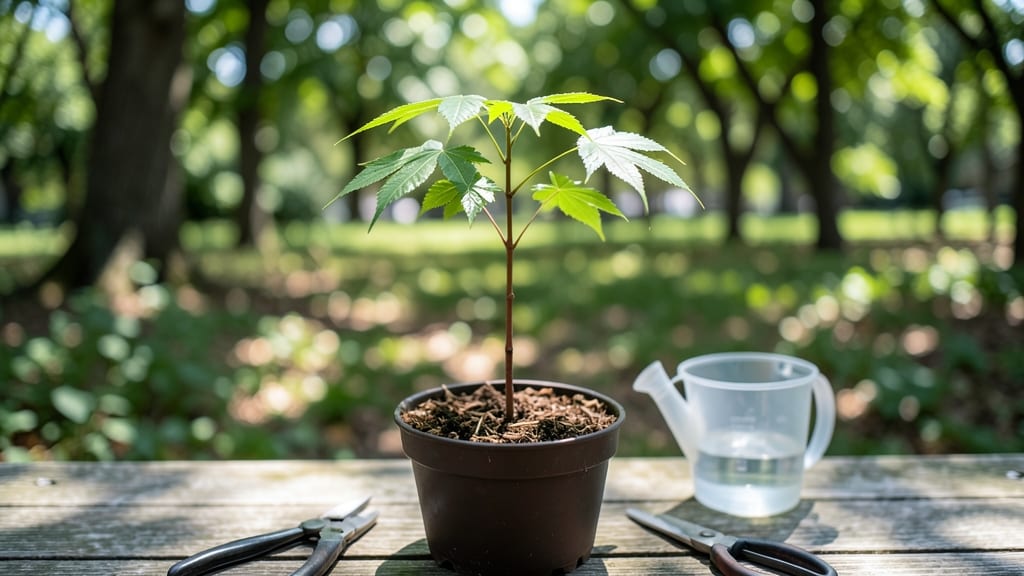
Maple seedlings look like small trees with palmate leaves featuring 3-5 pointed lobes and jagged edges, reaching 6-12 inches in their first year. Their delicate stems have smooth green bark that gradually develops faint ridges as they grow.
Young maple trees are easy to spot once you know what to look for—those distinctive lobed leaves are their trademark. 🌿 The leaf shape varies slightly by species, but most seedlings share that classic "hand-like" pattern with serrated edges.
Sugar maples often have more rounded lobes, while red maples develop pointed tips as they mature. The 6-12 inch height range in their first year means you'll find them at ground level, often growing in clusters where acorns or samaras have fallen.
What sets them apart from other seedlings is that combination of leaf structure and bark texture. The smooth green stems with developing ridges are a dead giveaway when compared to oak or ash saplings, which typically have more angular growth patterns.
I always check for these features when identifying wild seedlings—it's the fastest way to confirm you've found a maple.
💡 In This Article
- Identifying Maple Seedling Leaves by Species and Growth Stages
- Field Guide for Spotting Young Maple Trees in Forests or Gardens
Identifying maple seedling leaves by species and growth stages
The most distinctive feature of maple seedlings is their palmate leaf structure, where lobes radiate from a single central point like fingers on a hand.
Sugar maple seedlings typically display 5 lobes with rounded tips, while red maple saplings often show 3-5 lobes that become more pointed as they mature. Silver maples stand out with 3-7 lobes, often more deeply divided and with a silvery underside that develops as they age.
Leaf veins play a crucial role in identification—the primary veins extend directly to each lobe tip, creating a web-like pattern. In young seedlings, these veins are particularly visible against the bright green leaf surface, which contrasts sharply with the lighter green or yellow-green veins.
The serrated edges of each lobe are another key feature, with 12-20 teeth per inch along the margin. This fine-toothed pattern helps distinguish maple seedlings from oak saplings, which have rounded lobes with fewer, more pronounced teeth.
Juvenile leaves differ significantly from mature foliage. Seedlings often produce smaller leaves (1-3 inches wide) that are more rounded and less deeply lobed, while mature trees develop the classic 3-5 inch leaves with pronounced lobes.
Seasonal changes also affect appearance—spring seedlings emerge with reddish-purple leaves that gradually turn green, while autumn brings vibrant yellow, orange, or red hues depending on the species. This color transformation is most dramatic in red maple seedlings.
Bark texture provides additional clues. Young maple stems are smooth and green, but develop subtle horizontal ridges by their second year. These ridges become more pronounced with age, eventually forming the familiar interlocking pattern of mature maples.
The contrast between the smooth green stems of seedlings and the rougher bark of older trees helps distinguish different growth stages in the field.
Consider these key differences when identifying seedlings:
- Sugar maple: 5 rounded lobes, bright green leaves, smooth gray bark developing early
- Red maple: 3-5 pointed lobes, reddish spring foliage, reddish stems when broken
- Silver maple: 3-7 deeply divided lobes, silvery undersides, asymmetrical leaf bases
The most reliable identification period is late spring to early summer when leaves are fully developed but before autumn colors obscure key features. Early morning light enhances leaf details, making the vein patterns and lobe shapes more visible for closer examination. 🌿