
Propagation
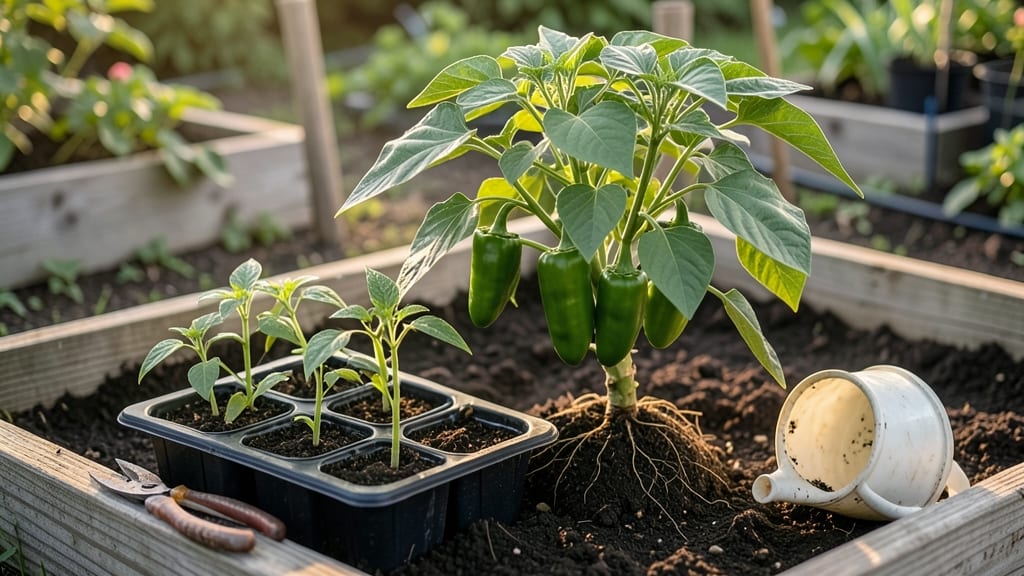
Growing Goliath jalapeno seeds starts with a trick that makes all the difference—cold-stressing the roots before transplanting. 🌱 I learned this after my first batch of seedlings stretched like overcaffeinated teenagers, weak and leggy.
The secret? Chilling the soil mix before planting forces roots to grow deeper and stronger, setting up plants that can handle heat and produce those massive, 12-ounce peppers we all dream of.
You'll need a 50/50 mix of potting soil and perlite, seed-starting trays, and patience—these seeds take 10-14 days to germinate. Plant them ¼ inch deep and keep the soil warm (70-85°F) with a heat mat if your home runs cooler.
Once sprouted, give them 6-8 hours of sunlight daily, and watch those first true leaves appear—proof you're on the right track.
By the time you transplant (after 4-6 weeks and when night temps stay above 55°F), your seedlings will be stocky, not spindly. The payoff? Plants that top 4 feet tall with thick stems and fruit that rivals a small football.
Just don’t skip the cold-stressing step—it’s what turns good peppers into showstopping giants.
Works for zones 8-10 as direct-sown seeds, but in cooler areas, start indoors 8-10 weeks before last frost. The key is consistency: water at soil level (not overhead) and feed with balanced fertilizer every 2 weeks once flowers appear. Now, let’s get those seeds in the ground!
📚 In This Guide
- What you need
- Instructions
- Tips and common mistakes
- Wrapping up and next steps
What you need
- ● Goliath Jalapeno seeds – 10–20 seeds (adjust based on desired plant count)
- ● Seed-starting mix – 5–10 lbs of sterile, well-draining potting soil (look for a mix labeled "seed-starting" or "organic potting soil")
- ● Seed trays or small pots – 4–6" deep, with drainage holes (biodegradable pots are eco-friendly!)
- ● Watering can or spray bottle – With a fine mist setting for gentle hydration
- ● Plastic wrap or humidity dome – To retain moisture during germination
- ● Grow lights or sunny windowsill – 6–8 hours of light daily (LED grow lights are ideal)
- ○ Fertilizer (optional but recommended) – A balanced, water-soluble fertilizer (5-10-5 ratio) or organic options like fish emulsion
- ○ Thermometer (optional but helpful) – To monitor soil temperature (ideal range: 70–85°F for germination)
- ○ Gloves (optional) – To protect hands from soil and peppers (they can be spicy!)
- ● Trowel or small shovel – For transplanting seedlings later
- ○ Pruning shears (optional) – For trimming excess growth as plants mature
- ● Cold-stress setup (key for Goliath Jalapenos!) – A refrigerator or cool basement (40–50°F) for 2–3 weeks before transplanting outdoors (this hardens roots for cold tolerance!)
- ● Sturdy stakes or trellis (for later) – To support the plants as they grow tall (Goliaths can reach 5+ feet!)
Step-by-Step instructions for growing cold-stressed Goliath Jalapeno plants
Here's how to coax those massive, heat-loving peppers to thrive through a clever cold treatment that strengthens roots before summer heat arrives.
🌱 Step 1: Start Seeds Indoors with Cold Treatment
Fill 2-3 inch deep seed-starting trays with moistened seed-starting mix (never garden soil—it's too dense). Plant 3-4 seeds per cell at ¼ inch depth since Goliath jalapenos germinate slowly. Cover lightly with additional mix and mist until evenly damp.
Place the tray in a refrigerator for 7-10 days—this cold treatment mimics winter chilling and triggers stronger root development. I like to check daily for condensation buildup; wipe the lid with a paper towel if you see water droplets to prevent fungal growth. The seeds won't sprout yet, but the cold stress primes their genetic potential for massive growth.
💧 Step 2: Germinate Under Warm Conditions
After cold treatment, move the tray to a warm location (75-85°F) where it receives 12-14 hours of light daily. Use a seedling heat mat if your home runs cooler. You'll see sprouts in 10-14 days, though some stubborn seeds may take up to 3 weeks—don't rush germination with extra water.
Once seedlings emerge, remove the humidity dome immediately to prevent damping-off. Water gently from the bottom by placing the tray in ½ inch of water for 10 minutes—this encourages deep root development. You'll notice stronger stems and deeper green leaves compared to seedlings that germinate without cold treatment.
☀️ Step 3: Harden Off Gradually Before Transplanting
Two weeks before your last frost date, begin hardening off by placing seedlings outside in partial shade for 1-2 hours daily. Gradually increase exposure over 10-14 daysfull sun (6+ hours daily) to reach their towering potential, but their cold-stressed roots handle transplant shock better than untreated plants.
Watch for first true leaves (the second set after the initial cotyledons) before transplanting. These leaves indicate the plant has developed enough energy reserves to support its massive growth. Transplant after soil warms to 60°F+—cold soil stunts root growth and delays maturity.
🪴 Step 4: Plant Deeply in Nutrient-Rich Soil
Dig holes twice as deep as the root ball to encourage additional root development. Goliath jalapenos can grow 4-5 feet tall, so their roots need space to anchor. Mix 2 inches of compost into the bottom of each hole and water deeply before placing the plant.
Fill the hole with soil, pressing gently to remove air pockets, and water again to settle the roots. Mulch with 2-3 inches of organic mulch to retain moisture and regulate soil temperature. You'll see new growth within 7-10 days—this confirms the cold treatment paid off with stronger, more resilient plants.
✂️ Step 5: Prune and Support for Maximum Growth
As plants reach 18-24 inches tall, install sturdy cages or stakes to support their weight. Goliath jalapenos produce heavy fruit, and unsupported plants may topple. Prune suckers (the small shoots that form in the leaf axils) to direct energy toward fruit production rather than foliage.
Harvest peppers when they reach 3-4 inches long for maximum heat and flavor. The cold-stressed roots ensure consistent production even in hot summers. You'll notice fewer blossom-end rot issues (a common problem in peppers) because the plants handle temperature swings better than untreated varieties.
Tips & tricks for growing cold-stressed Goliath Jalapeno plants
Took me a while to figure these out, so here's how to maximize your Goliath jalapenos' potential without the usual growing headaches.
Cold Treatment Precision: The 7-10 day refrigerator period is non-negotiable for those cold-stressed roots, but here's the secret: use the coldest part of your fridge (usually the bottom shelf) where temps hover around 38-40°F. This mimics natural winter chilling better than warmer fridge areas. I wrap my seed trays in a thin towel to prevent temperature fluctuations—consistency is key. After the 10 days, don't rush to warm conditions; let the seeds acclimate for 12 hours at room temperature first to avoid shock.
Lighting Strategy: Those 12-14 hours of light in Step 2 are critical, but quality matters more than quantity. LED grow lights positioned 6-12 inches above seedlings work best—closer for cooler temps, farther for warmer. I've found that blue spectrum LEDs (around 450nm) promote stronger stems, while adding 10% red spectrum (660nm) boosts leaf development. If using natural light, place seedlings on a south-facing window and supplement with a timer-controlled grow light during cloudy days.
Transplant Timing Secret: The soil temperature requirement of 60°F+ is often misunderstood—it's not just about air temperature. Use a soil thermometer to verify before transplanting. I've had failures when air temps were perfect but soil remained cool from recent rains. For extra insurance, plant in black plastic pots filled with warm water for 24 hours before transplanting—this creates a microclimate that mimics summer conditions and helps roots establish faster.
Harden Off Like a Pro: When increasing sunlight exposure in Step 3, I start with just 1 hour on day one, then add 30 minutes each subsequent day. The gradual approach prevents sunburn on tender leaves. Here's what to watch for: if leaves curl or develop white patches, you're moving too fast—backtrack by one day. Also, avoid hardening off during windy conditions; use a temporary windbreak if needed. The goal is to toughen leaves without shocking the plant system.
Pro Tips for Goliath Jalapeno Seeds
- Took me a while to figure these out, so here's how to maximize your Goliath jalapenos' potential without the usual growing headaches.
- This mimics natural winter chilling better than warmer fridge areas.
- Lighting Strategy: Those 12-14 hours of light in Step 2 are critical, but quality matters more than quantity.
Frequently asked questions
Got questions about growing Goliath Jalapeno seeds? You’re not alone! Here are some of the most common queries—and their answers—to help you cultivate these cold-stressed, towering peppers like a pro.
How long does it take for Goliath Jalapeno seeds to germinate?
With cold-stress treatment, germination typically takes 2–4 weeks. Start seeds indoors 8–10 weeks before your last frost date, using a peat-based growing mix and keeping them in a warm (70–80°F) environment. Patience is key—these seeds need time to break dormancy!
What’s the best way to cold-stratify Goliath Jalapeno seeds?
Place damp seeds in a sealed bag or moist paper towel, then refrigerate for 10–14 days at 35–40°F. After stratification, sow them ½ inch deep in warm soil. Avoid freezing—just a cool chill mimics winter conditions and triggers germination.
Can I grow Goliath Jalapenos in containers, or do they need a garden bed?
These peppers thrive in 5-gallon containers with well-draining soil and stakes for support. Just ensure pots have drainage holes and use a balanced fertilizer (like 10-10-10) every 3–4 weeks. Containers let you control soil warmth and moisture better than garden beds.
Why aren’t my Goliath Jalapeno plants producing peppers?
Common culprits: not enough light (12+ hours/day), overcrowding, or nutrient deficiencies. Prune suckers, thin plants to 18–24 inches apart, and switch to a low-nitrogen, high-phosphorus fertilizer (like 5-10-10) when flowers appear. Heat stress (above 90°F) can also halt fruiting—provide shade if needed.
Are Goliath Jalapenos hotter than regular jalapenos?
Yes! While both are mild to medium (1,000–5,000 Scoville units), Goliaths develop a slightly spicier kick as they mature due to their unique cold-stress growth. For milder heat, harvest them younger. Pro tip: Freeze or pickle them to lock in flavor!
Wrapping up and next steps
Growing Goliath Jalapeno seeds with cold-stressed roots is your ticket to harvesting massive, flavor-packed peppers—but the real magic lies in patience and precision.
By mastering the cold-stress technique and providing the right care, you’re not just growing peppers; you’re cultivating a thriving, high-yielding plant that’ll wow your garden (and your taste buds!).
Ready to take the next step? Start with a few seeds this season, experiment with your setup, and soon you’ll be sharing your goliath-sized jalapenos with fellow gardening enthusiasts. Happy growing! 🌱🔥